ADAPTIVE NEXUS / WOLVERHAMPTON / ARCHITECTURAL DESIGN RESEARCH

YEAR4th Year Project

UNITDiploma 14

STUDIOBlack Country Green Belt Grey Field

TUTORSPereen d'Avoine
Pierre d'Avoine

Adaptive Nexus

A bottom-up framework for affordable live-work settlement on Wolverhampton’s Green Belt edge.

Adaptive Nexus is a bottom-up live-work settlement framework for Wolverhampton, situated within the UK’s emerging Grey Belt debate and the wider pressure to deliver more affordable housing. Rather than replacing the Green Belt edge with another fixed masterplan, it begins with the existing landscape—waterways, trees, informal paths, allotments and reusable material traces—and asks how limited, low-impact occupation might support homes, work and local economic life.

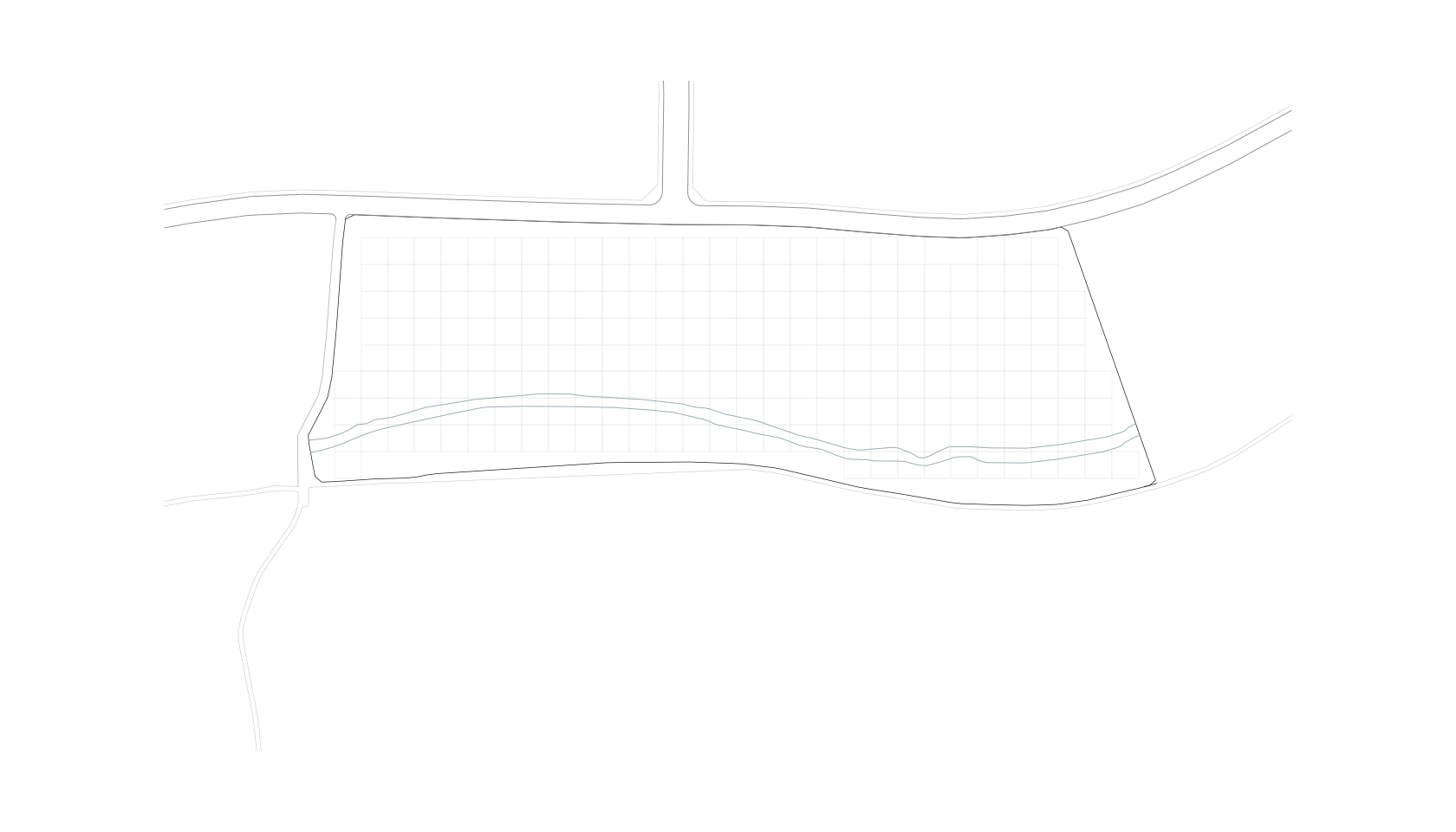
A 10 × 10 metre grid acts as a minimum rule through which residents can begin with a low-cost, demountable core unit and expand only when their household or work activities require it. The settlement develops through spontaneous order: accumulated choices and negotiations rather than a plan imposed from above.

A short household conversation is used to generate explainable plot options. Recommendations are recalculated against the settlement’s current state—including land already occupied by earlier households, remaining capacity and the declared activities, offers and needs of nearby anonymous residents. People may accept, reject or revise the options, and every selection changes what remains available to those who arrive later.

The current system is transparent and rule-based. An earlier LightGBM and OR-Tools prototype tested cell-level prediction and constrained planning, while a future learning phase will investigate how anonymous accept, reject and revise choices can improve the ordering of already feasible plots. Hard environmental and spatial constraints will remain explicit and non-learned.

01

A framework for reviewable growth

The project treats a masterplan as a sequence of inspectable choices rather than a finished image. One complete ten-by-ten-metre cell can hold a residential core; one adjacent cell can support growing, making, storage, hosting or landscape work.

The two-cell envelope is an analytical placement unit. It is not proof that construction fits, that land is developable, or that any resident preference has been validated.

02

Territory and a provisional edge

Wolverhampton / current-site parameterisation

Green Belt / potential grey-belt language is a research condition, not a planning designation. The analytical water mask is not a legal flood, ecology or developability boundary.

03

Site, grid and ecological limits

Complete-cell review / unresolved micro-footprint

04

Unit, assembly and support space

Architectural sources / three distinct conditions

Three authored architectural conditions

The scenarios remain architectural material. They are not learned resident outputs.

05 / VOICE SPATIAL PROFILE

A local conversation, not a hidden score

Synthetic demonstrator / no storage

A household-first local conversation becomes a spatial brief you can inspect and change before any site preference or plot recommendation begins.

06 / CURRENT TRANSPARENT NON-LEARNING SYSTEM

How a resident profile becomes a plot family

The current system does not predict one best cell.

It enumerates every complete core-and-support bundle, removes options that violate explicit limits, and compares the remaining bundles in the resident's declared priority order. Exact ties remain visible for review rather than being collapsed into a false winner.

  1. 01 / PROFILE

    A short conversation becomes explicit spatial statements.

  2. 02 / EVIDENCE AUTHORITY

    Each statement is marked as used, blocked or unresolved.

  3. 03 / BUNDLE ENUMERATION

    Every complete residential core and adjacent support pair is generated.

  4. 04 / HARD FILTERING

    Declared limits, provisional infrastructure and occupied cells remove invalid bundles.

  5. 05 / ORDINAL RANKING

    Remaining bundles are compared in priority order without one hidden weighted score.

  6. 06 / OPTION FAMILY

    Exact ties remain visible as Sample A, B and C for review.

EARLIER ML PROTOTYPELightGBM cell prediction followed by constrained OR-Tools selection

CURRENT EXPLAINABLE BASELINEdeterministic bundle enumeration, hard filtering and ordinal ranking

PREFERENCE LEARNING — IN DEVELOPMENTfuture soft re-ordering of already-feasible alternatives

07

Anonymous settlement growth

One explicit two-cell choice at a time

08

Local settlement demonstrator

Choose a complete core-plus-support bundle, add it under an anonymous synthetic ID, and watch the next option family recalculate after occupation. Typed links and declared tensions remain separate; no community scalar is created.

09 / COMPUTATIONAL DEVELOPMENT

Computational development

From an earlier cell-prediction experiment to an explainable baseline and preference learning.

01 / EARLIER ML PROTOTYPE

A limited family play-space experiment used LightGBM to estimate per-cell next-state suitability from a synthetic spatial sequence.

OR-Tools then selected a site-scale candidate field under minimum-area, exclusion and policy-weighting constraints.

This experiment tested a learning-and-planning workflow. It is not the engine used for the current resident plot recommendations.

02 / CURRENT EXPLAINABLE BASELINE

The current demonstrator does not train a model.

It evaluates every admissible core-and-support plot bundle, removes options that violate explicit constraints, and compares the remaining alternatives in the resident’s declared priority order.

Exact ties remain visible as an option family, allowing every recommendation to be traced back to the profile, site evidence and rules that produced it.

03 / PREFERENCE LEARNING — IN DEVELOPMENT

The next experiment will learn how users order already-feasible plot options from anonymous interaction records.

The learning dataset will contain A/B/C comparisons, accept and reject decisions, requests for additional options, profile revisions and the final bundle retained for the local simulation.

The first benchmark will compare a Bradley–Terry pairwise-choice model with a LightGBM ranking model against the current transparent baseline.

The model will learn only the soft re-ordering of feasible alternatives. Environmental exclusions, occupied cells and other hard site constraints will remain explicit and non-learned.

STATUS

The interaction and data-capture interface is currently under development. No model has yet been trained on real visitor choices.