Existing tables for four.
With the default 0.05 avoid band and no other occupants, six tables meet the approach band and twelve meet the avoid band. Four-person groups can occupy at most eighteen tables at once: 72 grouped people, despite 100 seats.
PERSONAL DIFFERENCE → SHARED SPACE
Each person may have a place to go.
That does not mean they have a place to stay together.
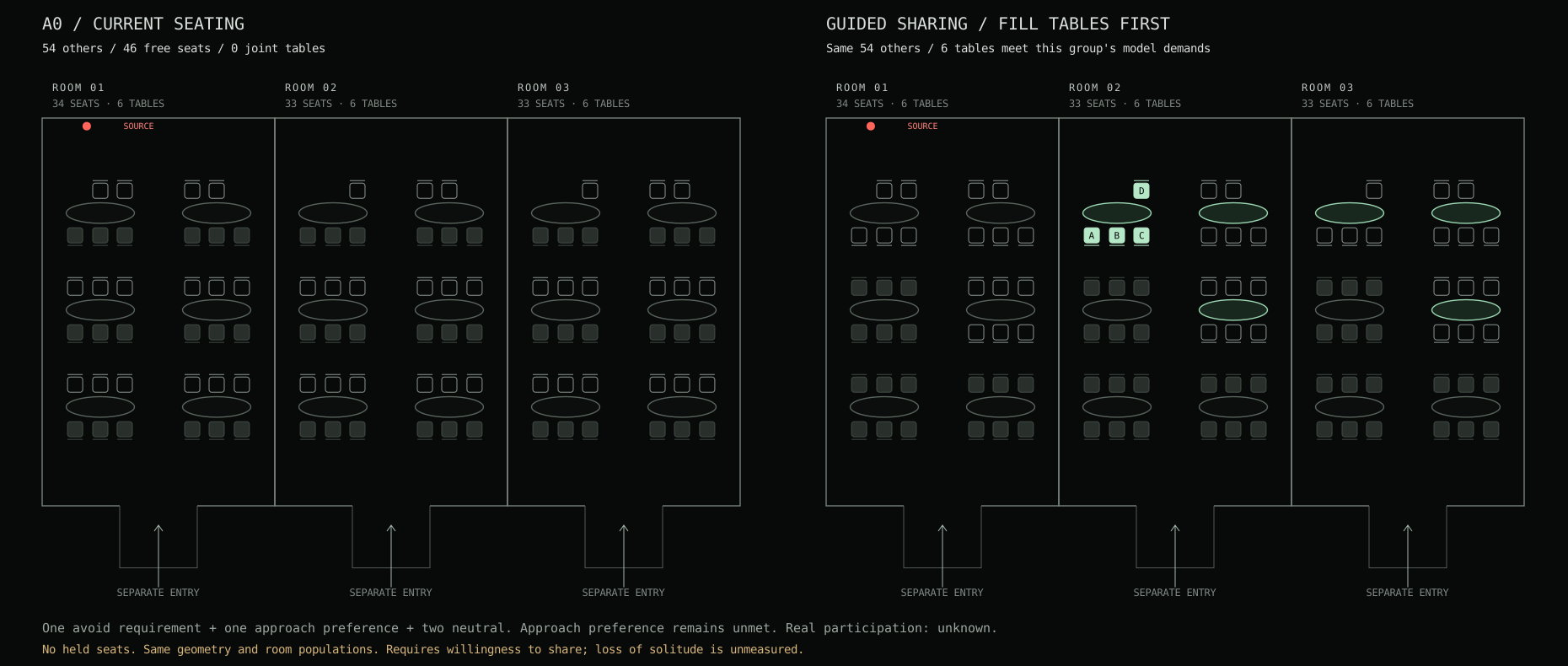
Actual seat and table coordinates. Boundaries and vestibules are schematic. No seat-level concentration field is implied.
Actual participation: unknown. Seeing the document, hearing one another and experiencing the scent still require observation. Green means the stated layout and selected-compartment model demands are met.
SAME PEOPLE / SAME ROOMS / SAME AIR MODEL
Both allocations allow unrelated occupants at a table. Requiring a private table would reduce capacity. These examples do not estimate how often real groups arrive or how people choose.
DIRECT SOLVER / P10 / FIXED GEOMETRY
Twenty minutes from closed-door steady state, with a continuous tracer source in Room 01. Reference door traffic is fixed independently of the seat-occupancy example; it is not a crowd simulation. The primary curves average the lower 0–2.2 m layer. Switch to room-volume means to inspect the earlier diagnostic. Neither resolves individual seats. Seating is assessed against their time means; playing the trace does not change the demand definition.
Continuous interpolation between two-second solver samples. Playback is 60×; no invented seat-scale flow or measured tea emission. The earlier release-and-clearing Film is a different protocol.
OPEN RELEASE + CLEARING FILM ↗ALL DECLARED OCCUPANCIES / NO SCENT REQUIREMENT
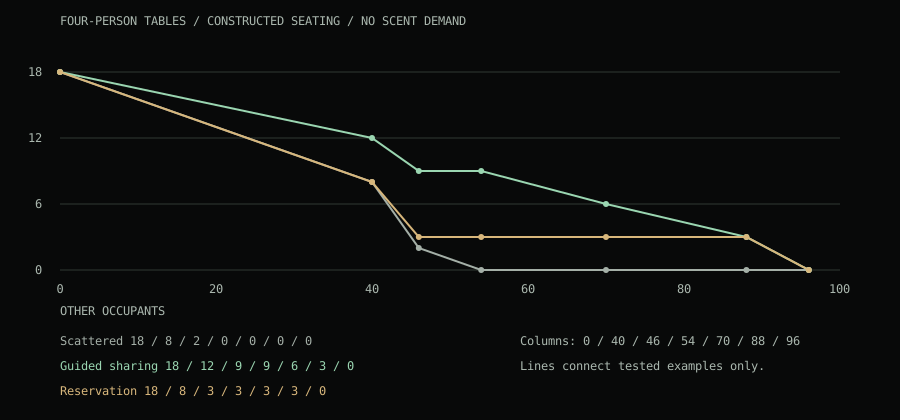
Constructed allocations, not observed arrival frequencies. Fill-first asks people to share tables; acceptance and loss of solitude are not measured. It is the first operating candidate to test, not a proven behaviour.
At the 0.001 band, Room 03 has six empty-layout candidates with room-volume means in all four transport cases. With the primary lower-layer mean, both ±5 Pa cases have zero. Their lower-layer C* is 0.001080 / 0.001140. The nominal and held-open cases retain six. Do not call Room 03 robustly below this stricter demand.
WHAT THE COMPARISON ESTABLISHES
With the default 0.05 avoid band and no other occupants, six tables meet the approach band and twelve meet the avoid band. Four-person groups can occupy at most eighteen tables at once: 72 grouped people, despite 100 seats.
With 54 scattered occupants, 46 seats remain but no table has four free seats. Guided table sharing leaves nine group tables under the same room populations, with no seats held. Reservation leaves three, holding twelve seats from walk-ins. Sharing may conflict with wanting to sit alone.
Disjoint required compartment-average bands cannot coexist at one table in this model. Actual seat-to-seat differences are unresolved. A transparent wall alone does not establish conversation or shared-document access.
This fixed-geometry group study is preserved as prior evidence. The current work uses the existing Rhino model, explicit hypothetical demands, new spatial alternatives and matched drawings. No real venue or participant seat list is required for this stage.
COMPARE SPATIAL A/B/C ↗Working activity: a shared lounge with tea preparation at the existing source location. The source remains an uncalibrated tracer; tea is a program assumption. Four profiles are tested: all approach, all avoid, mixed with one negotiable preference, and mixed with both conflicting demands required.
896 comparisons cover four direct transport cases × two exposure metrics × two seating patterns × two avoid bands × seven background occupancies × four profiles, each with and without reservation. Exact simultaneous table matching is checked for all 351 approach/avoid group-count combinations up to 25 groups. Four-person groups cannot share an existing table with another four-person group because every table has fewer than eight seats.
Counterexample: at 46 clustered occupants, A0 already has nine four-seat tables. At low occupancy reservation is unnecessary, and at 96 occupants it cannot create capacity. At 40 scattered occupants, both A0 and A1 have eight generic group tables; fill-first has twelve. No reduction in candidate count from reservation was found in the declared grid. These are constructed layouts, not frequencies or a universal adoption score.
The 54-occupant illustration was added after the 46-occupant allocation still left two group tables. This is an explicit diagnostic amendment, not a held-out success. Background room populations are matched; arrivals are assumed able to use the assigned same-room seats. Willingness to do so is unmeasured.
Current Rhino export: 100 seats and 18 tables, including twelve six-seat, four five-seat and two four-seat tables. Seats are mapped to the nearest table in their room and face toward it. Saved-model chair transforms and table bounds were checked. Furniture, partitions, doors, source and ventilation remain unchanged in A1. The solver cannot resolve furniture effects or local breathing-zone exposure.
Possible / impossible / unknown refers only to the declared constraints and available evidence. Physical participation remains unknown for both A0 and A1. No unknown is counted as a design success or failure. This is constraint matching, not machine learning.
Protocol · All comparisons + checks · Direct solver traces · Seat/table coordinates · Comparison drawing