SCENT COMMONS / V118 PUBLICATION / V116–V117 RESULTS / 10 NOVEMBER 2026
Better settings.
The same choice with or without ML.
Drawing more extraction from the lower layer improves the simulated Room 03 concentration. ML and interpolation each select a setting from predicted concentrations. In these tests, ML does not change or improve the choice.
This is the original fixed three-room vestibule and two-layer model. Room 03 is the lower-exposure retreat. A continuous tracer source stays in lower Room 01, with local extraction fixed at 360 m³/h. The final straight and curved 72-seat rooms are a separate spatial study; none of the percentages here transfers to them.
Later study: a learned seat-level instrument for the final two 72-seat rooms → This original three-room result remains unchanged.
What data did ML use, and what did it predict?
The ventilation model used 3,868 concentration examples generated by the original simulator. These are synthetic physics-model outputs, not sensor readings or people’s smell ratings. Both predictors received the same examples. The public DREAM and Bierling smell-rating datasets belong to earlier preference studies, not to this ventilation training set.
The frozen ML model learns a correction to scaled interpolation. It predicts nine concentration summaries: the lower-layer mean, whole-room mean and sampled maximum for each of three rooms. The predicted concentrations screen ventilation settings against a target and eight protected outputs. The original simulator then checks the selected settings. Exhaustive evaluation checks each declared objective across the menu: lower worst Room 03 mean in V116, lower supply with the frozen tie rule in V117.
Prediction and choice are different tests: a lower prediction error does not necessarily produce a better design decision. Here, ML and interpolation selected the same settings. The earlier ML adoption gate remains failed and scaled interpolation remains the default.
V116 / Same supply, a different extraction split
At 4,680 m³/h total supply, changing lower-layer general extraction from 50% to 75% reduces the worst Room 03 whole-room 20-minute mean by 28.5%. Total general extraction stays at 4,320 m³/h: its lower/upper split changes from 2,160/2,160 to 3,240/1,080 m³/h. No protected output worsens relative to the matched reference.
ML, interpolation, the predeclared 75% rule and the exhaustive menu search choose the same setting. The result holds at the other two tested supply levels and in all 24 wind-conditional comparisons. This is a service-setting result; no duct or room geometry was redesigned.
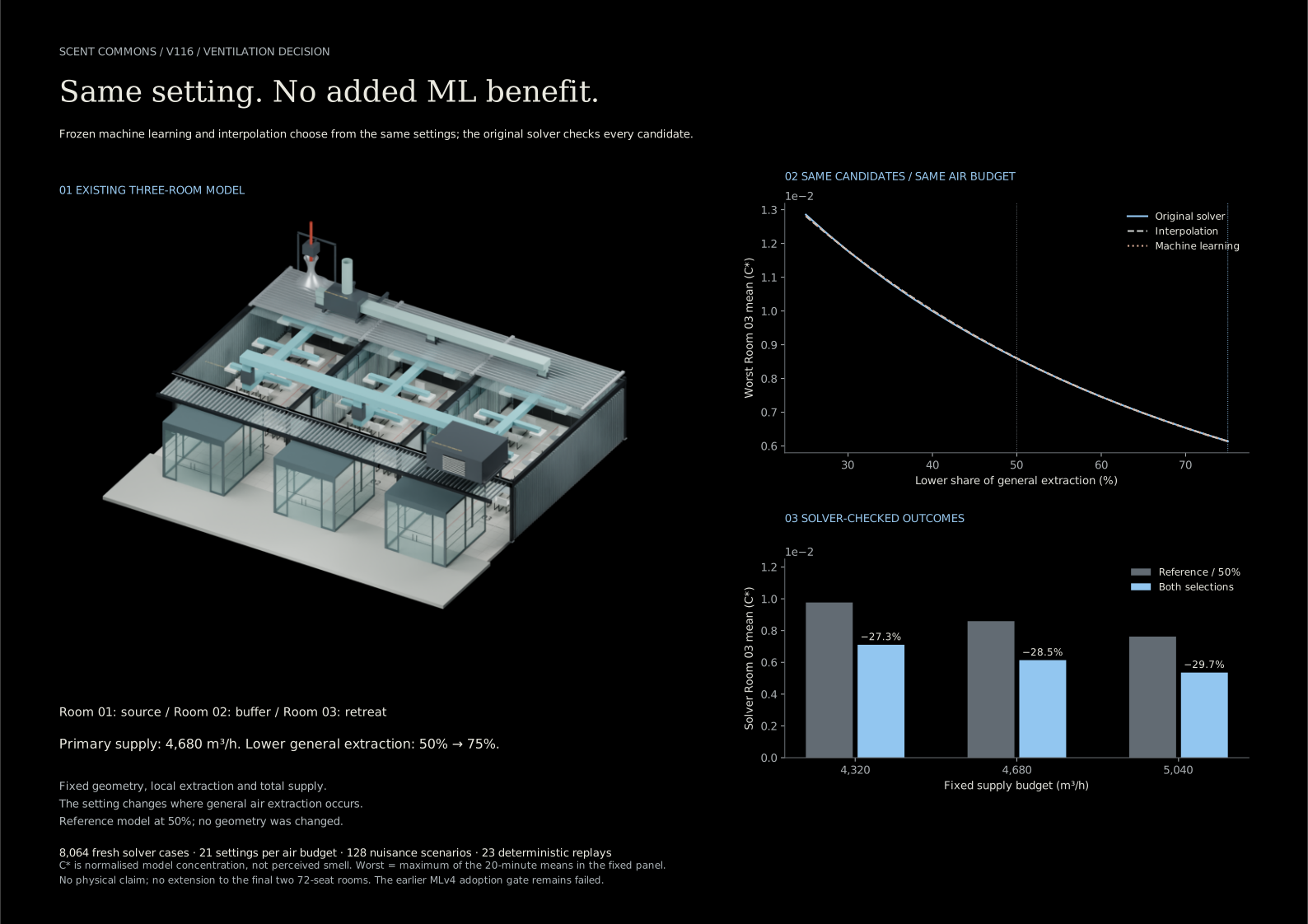
21 extraction splits × 3 supply levels × 128 nuisance scenarios = 8,064 original-simulator cases. The fixed-setting objective takes the largest whole-room 20-minute mean across each panel. All eight other summaries must not worsen in any matched scenario. A menu-edge optimum with improving protected outputs does not test difficult trade-offs.
V117 / How little supply meets the target?
The primary target preserves the reference worst Room 03 mean, using a new 128-scenario panel. Both predictors choose 4,320 m³/h at 62.5% lower extraction: 7.7% less supply than 4,680 m³/h, with the Room 03 mean reduced by 3.7%.
At the same 4,320 m³/h, 75% lower extraction also passes and reduces the mean by 17.4%, with larger minimum margins. The 62.5% choice comes only from the frozen tie rule: among equally low supplies, prefer the split closest to the 50% reference. Redistribution costs were not modelled. This is not a recommendation to prefer 62.5% in a real system.
The table shows the identical ML and interpolation choices. All pass the original simulator’s eight protected-output checks. A direct search using 75% lower extraction reaches the same minimum supply for each goal, with a different extraction split for the primary goal.
| Goal | Supply (m³/h) | Lower extraction | Room 03 mean reduction | Supply change |
|---|---|---|---|---|
| Preserve reference · primary | 4,320 | 62.5% | 3.7% | -7.7% |
| Reduce by 20% · sensitivity | 4,440 | 75.0% | 21.4% | -5.1% |
| Reduce by 25% · sensitivity | 4,560 | 75.0% | 25.1% | -2.6% |
| Reduce by 30% · sensitivity | 4,740 | 75.0% | 30.2% | +1.3% |
Supply changes are relative to 4,680 m³/h. The 30% reduction target requires more air. The 20%, 25% and 30% targets are sensitivity checks, not health or sensory limits.
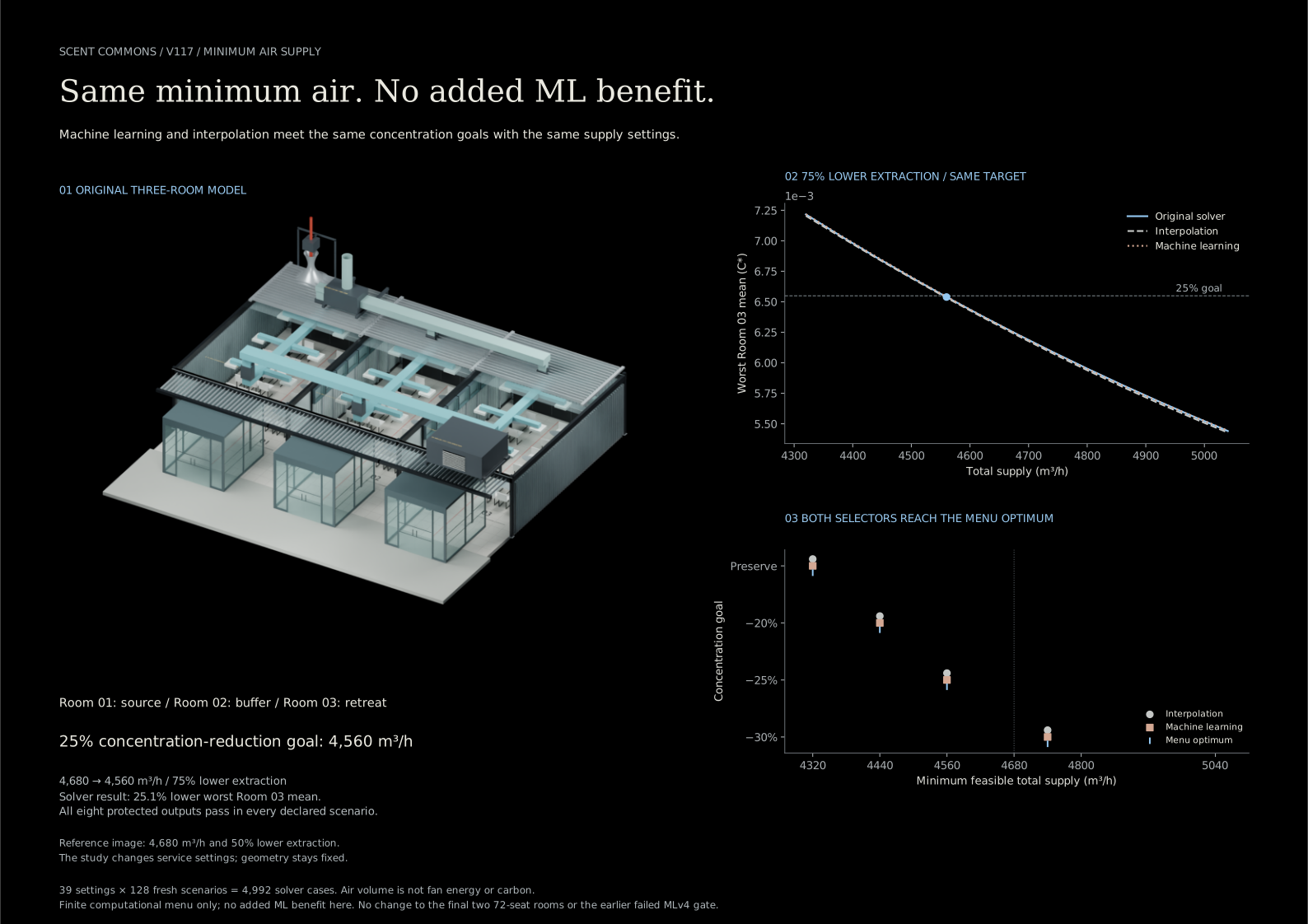
The 28.5% concentration reduction and 7.7% supply reduction are separate results. V116 and V117 use different scenario panels and reference concentrations (0.008591837 and 0.008731842 C*). They must not be presented as one combined improvement.
Did ML save calculation work?
ML and interpolation each need 256 distinct original-solver queries per V117 goal to obtain the shared reference and verify their chosen setting. Direct 75% search needs 256, 512, 768 and 1,152 respectively. Checking a selected setting proves feasibility; checking all 4,992 cases establishes the finite-menu minimum. These counts cover different amounts of certification work. They are not measured speedups and exclude prior training-data cost. ML adds no query advantage over interpolation here.
What this changes—and what remains unresolved
The study identifies useful ventilation settings in this model and tests ML in an actual selection loop. It does not establish added ML decision value on these panels, or prove that ML cannot help other problems. The failed historical adoption gate is preserved.
V117 compares 39 declared settings: supply from 4,320 to 5,040 m³/h in 60 m³/h steps, and lower extraction at 50%, 62.5% or 75%. The primary result is at the lower edge of that domain, not a global minimum. For the 25% target, the smallest goal margin is only 0.0000100 C*. Passing the finite nuisance panel is not a reliability guarantee.
C* is normalised model concentration, not perceived smell, comfort or measured dose. The panels vary wind, assumed bypass, temperature and door events; they are not sampled populations. Lower supply volume is not a measured energy, carbon or cost saving. Physical and perceptual validation remain future work.
The final 72-seat models, N1 mark, spatial-profile gains, visibility results and moving-exposure conclusions remain unchanged. Read those separate results in the evidence map.
Evidence and checks
V116 rebuilt 8,064 predictions and replayed 23 original-solver cases; V117 rebuilt 4,992 predictions and replayed 30 cases. Both recorded zero rebuild/replay error. Separate-rule recounts and source-hash checks were completed for both experiments. Claude reviewed the supplied code, protocols and results as text, without re-running them; this is not independent validation. V118 publishes the verified evidence without refitting or new simulation.
Public aggregate results and source hashes · Historical ML adoption result
This aggregate extract is labelled separately from the frozen source files. Original protocols, code and detailed evidence remain in the private archive. Raw fields, model weights, local filesystem paths and participant data are excluded from this publication.