SCENT COMMONS / SPATIAL CONCLUSION V115 / V118 VENTILATION ADDENDUM
More seat choices, conditional exposure
The retained design creates more qualifying seat choices under the declared virtual model and gives a separately recounted N1 visibility result. A shorter journey does not guarantee lower cumulative or peak exposure. The final geometry stays fixed. The largest tested shortcut that keeps the old visibility passes saves 11.8 mm and adds no qualifying profile.
The question remains: can people with different scent requirements move to another seat and rejoin a shared activity? The evidence supports additional modelled choices, with unresolved profiles and sightline conditions. It does not establish a universal reduction in smell, a validated human experience, or an overall advantage of curved over straight rooms.
One-page English A3 · Published aggregate evidence · How this was checked
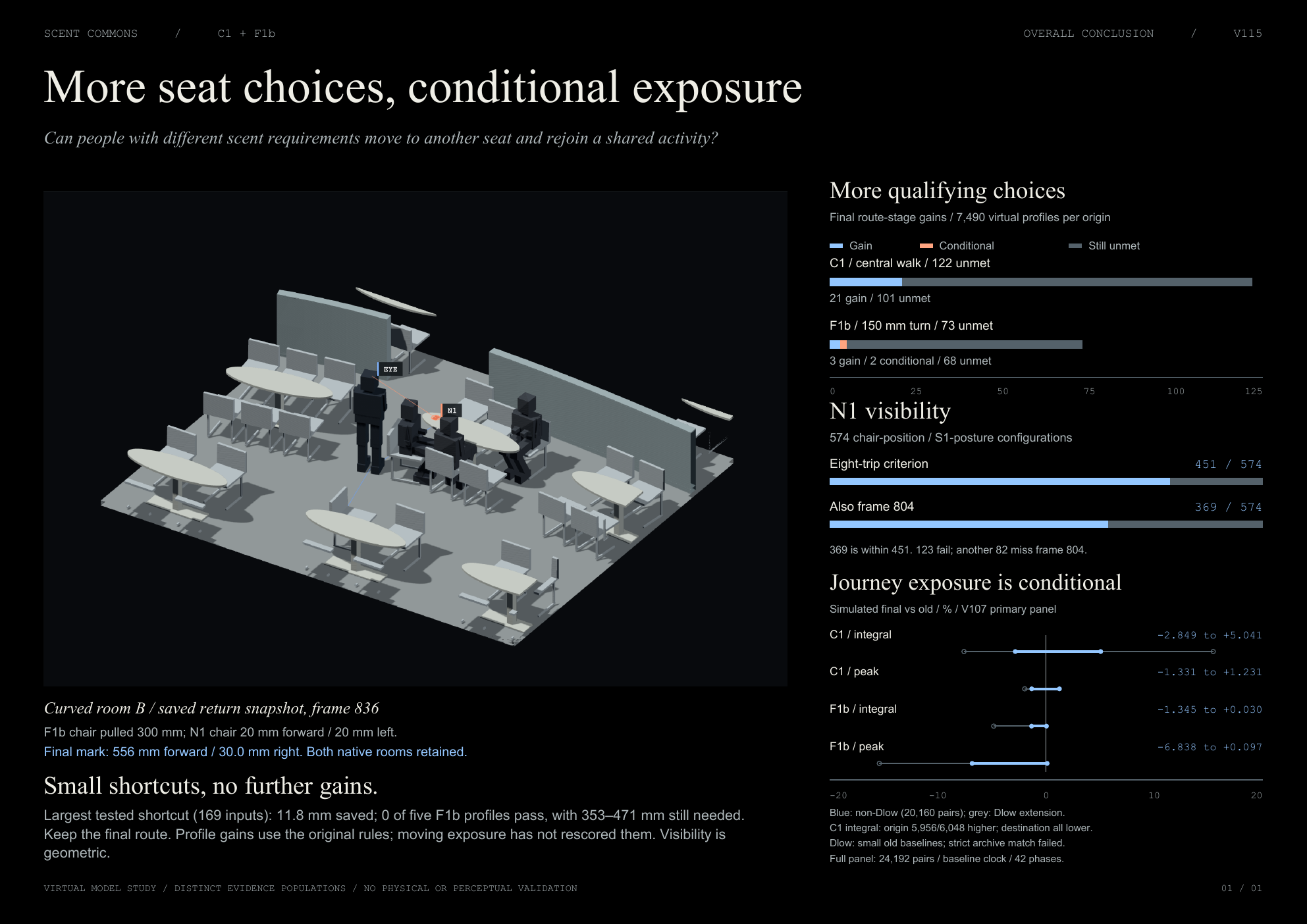
Three spatial questions, three denominators
There is no defined assignment from the virtual profiles to visibility configurations or dynamic exposure conditions. These populations are not added, multiplied or averaged into a single score. Links lead to public explanations and aggregate results. Detailed source records and native models remain in the private working archive. The moving-exposure study has not been fed back into the original eligibility rule; the original choice gains remain claims under that rule.
1. Keep the selected design and its original choice gains
N1 remains 556 mm forward / 30.0 mm right in both final native models. Approximately 29.02 mm remains an experimental visibility boundary. C1 retains its 30 mm walking lead-in; F1b retains the N1-specific departure turn at 150 mm, with the shared turn retained for five other destinations. The saved native files and left section show a return snapshot, not every tested or resting chair configuration.
C1 compares 122 previously unmet profiles with 21 new qualifying choices and 101 remaining unmet on the central walk. Its 21 gains persist in 361 saved outward/return offset pairs. That separate offset panel leaves 101 unmet in 235 pairs and 100 unmet in 126 pairs; those offset-dependent extra choices are not folded into the central-walk bar or summed as distinct profiles. F1b compares 73 previously unmet profiles with 3 gains throughout the fixed-150-mm panel, 2 conditional gains and 68 never qualifying. Each conditional profile passes at only three of 41 chair positions. There are no losses among previously qualifying profiles in these route-stage comparisons.
Earlier airflow and chair changes had their own baseline gains: 153 for the C1 local-airflow intervention and 37 for the F1b chair/sightline intervention. They remain historical design-selection evidence, not extra independent confirmations or a combined population rate. Across the separate 140/150/160-mm F1b exploratory panel, only two new profiles pass everywhere; that is not the fixed-150-mm result above.
2. Keep N1 visibility separate and nested
The main criterion requires at least 18/35 visible points throughout frames 57-83 on all four higher-torso trips and at least 306 passing frames on each of four broader-body trips. Eight trips cover two rooms, two occupancies and two body types. The frame-804 check is an additional condition within the main-pass set.
All 574 configurations pass the higher-torso departure window. The 123 main failures are all 41 chair positions under each of three S1 poses: back 30 mm, left 20 mm, and torso tilt -2 degrees forward / -2 degrees right. The other 11 postures pass the main criterion at all 41 chair positions. This is geometric visibility of sampled points, not a test of sign reading or human satisfaction.
3. Whole-journey exposure: the broad comparison
The A3 ranges use one matched comparison panel for both C1 and F1b: V107 primary42, six frozen air conditions, both rooms, two bodies, three overall speeds, 42 departure phases, 60/1,200-second minimum destination dwell and both spare-time policies. There are 24,192 pairs after verifying and removing identical occupancy copies (12,096 per origin). The frozen exposure fields do not react to the changed occupancy: these copies do not constitute an airflow or moving-crowd effect test. The separate held-door supplement and later clock/setup panels are not pooled into these ranges.
Each percentage is 100 x (final - old) / old for the same pair and metric. Negative is lower. These are finite envelopes of simulated conditions, not confidence intervals or field-error bounds. The numerical tie threshold is 1e-9 percentage points; it is not a physical uncertainty or perceptual threshold. The largest F1b increases are about +0.030% for the integral and +0.097% for the peak. Their signs are numerical findings in frozen fields; no quantified model/field uncertainty interval establishes their physical or perceptual significance. Cumulative integral, whole-window peak and all-motion peak answer different questions; a lower integral can coexist with a higher peak.
On the A3, the blue bar and printed values show the five non-Dlow fields; grey extensions show how including Dlow expands the envelope. The non-Dlow panel has 20,160 pairs, versus 24,192 in the full six-field panel. Dlow endpoints often have small old-arm denominators, so a large percentage is not a comparable absolute concentration change. Both Dlow fields are fresh same-solver recomputations whose strict original-archive reproduction checks failed. That limitation stays unresolved. Excluding Dlow, both origins still include cumulative and whole-window peak increases in the primary panel:
The negative and positive extrema can come from different conditions. These envelopes do not identify one best operating policy or show what is typical. The full endpoint identities and old-arm denominators are retained in the data ledger.
Where the saved time is spent matters
“Origin spare” places the time saved by the final trip back at its origin; “destination spare” places it at the destination. This is a scheduling assumption, not observed behaviour. Both arms use the same observation time within each comparison.
4. What the later sensitivity studies add
V109 uses fixed speed factor 1 and the baseline turn/posture clock, unlike the three-speed V107 panel. The factor levels and full grid were checked directly against all 241,920 saved V109 rows. Its counts are (4 C1 + 41 centred F1b + 3 extra starts x 5 F1b chair points) x 2 rooms x 2 bodies x 6 fields x 42 phases x 2 dwells x 2 spare policies = 241,920. The five centred F1b points are already among the 41, so they are not added twice. The V110 result refines the interpretation rather than moving the N1 mark again: a common clock shift can move both setups across zero while their relative setup effect keeps its direction. Sampling checks and small residuals verify calculations within frozen fields; they do not establish perceptual importance or physical field accuracy.
5. The design-evidence chain
The following retained V104 chain is historical model evidence with its original stage baselines. The whole-journey exposure evidence above extends the research separately; it does not silently alter these original eligibility results.
V112–V114 / REMAINING MOVEMENT BUDGETS
Small shortcuts do not resolve the remaining profiles.
The original movement caps stay fixed. A saved-score audit found 3 C1 and 47 F1b profiles in the travel-budget-only relief group. These are subsets of the 101 C1 and 68 F1b profiles still without a qualifying option. They are not counts of real participants.
The five closest F1b profiles needed 365–483 mm less travel to pass across all saved contexts. A 519.7 mm shortcut could meet their original travel scores, but failed the required broader-body visibility duration at all 41 centred-S1 chair settings: 287 frames against the unchanged 306-frame threshold. It was rejected.
The next search measured 169 declared inputs, including every 1 mm origin station from 150 to 300 mm and 18 grip combinations. The largest tested shortcut retaining the same 451 main and 369 nested frame-804 identities saves only 11.782 mm per full trip. This is a maximum within that discrete search, not a global or continuous optimum.
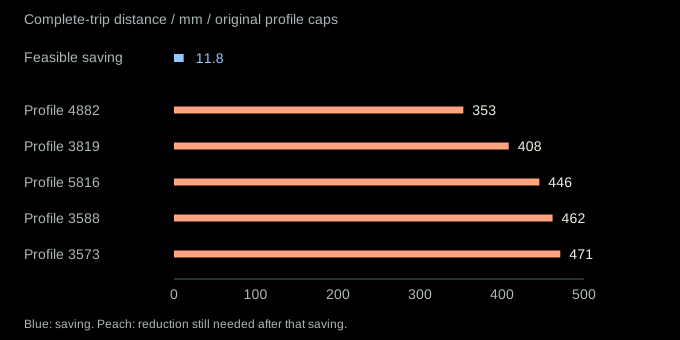
The 39.269 mm centred-S1 alternative retains only 369 of the old 451 main passes and 331 of the old 369 nested passes. Its 17 new nested passes cannot replace the old identities lost. It also adds none of the five profiles. Neither comparison is adopted.
Retain the current final route and N1 at 556 mm forward / 30.0 mm right. At the all-set 11.782 mm candidate, each of the five profiles still passes 0 of its 2,952 saved contexts; its worst-context shortfall remains 353–471 mm. F1b remains 7,420 always qualifying, 2 conditional and 68 never qualifying. C1 remains 7,389 qualifying and 101 unmet. No moving-exposure calculation or eligibility threshold was changed.
Further decimal refinement is not the next research need. A future design experiment would need a materially different path or layout with enough potential saving to meet those remaining budgets, while preserving departure, collision, return and visibility. This synthesis does not propose or validate that new design.
V112 / original budget gaps · V113 / rejected half-metre shortcut · V114 / smaller-route comparison · Aggregate results
A separate ventilation decision test
V116 and V117 return to the original three-room model. Simulator-trained ML predicts room concentrations to select ventilation settings, then the original simulator verifies the choices. At 4,680 m³/h supply, the selected split reduces the worst Room 03 mean by 28.5%. A separate minimum-air test meets the reference target with 7.7% less supply. These are different tests, not a combined improvement.
ML and interpolation choose the same settings. Direct 75% search reaches the same minimum supplies, with a different extraction split for the primary goal. The earlier ML adoption gate remains failed. None of these figures changes the two-room spatial results on this page.
Read the data, choices, tie-rule caveat and finite-menu limits →
6. What is finished and what remains
Verification and provenance
The earlier V111 synthesis re-read 48,384 V107 rows and verified identical occupancy copies before counting 24,192 unique comparisons. It checked the full 241,920-row V109 condition grid and the later timing aggregates. It retained the earlier visibility recount and verified 2,902 source-file hashes, including both final Rhino models. V115 checks the retained aggregates and 2,335 prior-version file hashes. No new simulation or physical experiment was run for this publication synthesis; V113 and V114 did run the separately documented motion and visibility replays.
Codex prepared and checked the synthesis; Claude reviewed its presentation and calculation summaries within a bounded scope. Their agreement is not physical validation. The V115 A3 retains the V111 room section and three distinct graphs, adding the V112–V114 travel-budget conclusion. These later studies do not alter the final design or add qualifying profiles. Detailed source code, model archives and review receipts remain private. The downloadable aggregate evidence records the displayed exposure ranges and their population definitions.
Download aggregate evidence · Browse the earlier research record